How to Verify a Georgia Residential Contractor License in Five Minutes
Quick answer: In Georgia, anyone paid to build or remodel homes as a residential contractor must hold a state license. You can check one for free on the Georgia Secretary of State website: open Licensing, choose Licensee Search, pick Residential and General Contractors, and search the company name or license number. A good result shows the right company name and a status of Active.
Before you trust anyone with the biggest purchase of your life, take five free minutes to confirm the builder is who they say they are. These are the checks we would run on any builder, including ourselves.
Who needs a contractor license in Georgia?
Any person or company that performs, or offers to perform, residential or general contractor work for pay in Georgia must be licensed by the State Licensing Board for Residential and General Contractors, according to the Georgia Secretary of State. The governing law is O.C.G.A. Sections 43-41-1 through 43-41-17.
Two groups are handled differently. Specialty trades such as roofers, painters, drywall installers and repair handymen are not licensed by the state. Plumbers, electricians and air-conditioning contractors are licensed by a separate body, the Georgia Construction Industry Licensing Board, as the Attorney General's Consumer Protection Division explains. The builder running your new home, though, should hold the residential contractor license.
A license is not a formality. Under the board's rules, an applicant for the residential-basic license must be at least 21, show at least two years of residential building experience, pass a state exam covering codes, contracts and lien law, and prove general liability insurance of at least $300,000 plus workers' compensation as Georgia law requires (Rule 553-3-.01).
Step 1: Ask for the exact company name and license number
Ask the builder for the legal business name and license number, in writing. A licensed builder will give both without hesitation. Note the company name exactly as it appears on the contract.
Step 2: Search the Georgia Secretary of State license lookup
Go to sos.ga.gov, open Licensing, then Licensee Search. Under Building and Contractors, choose Residential and General Contractors. This route comes straight from the Attorney General's consumer guidance. Search by license number or company name.
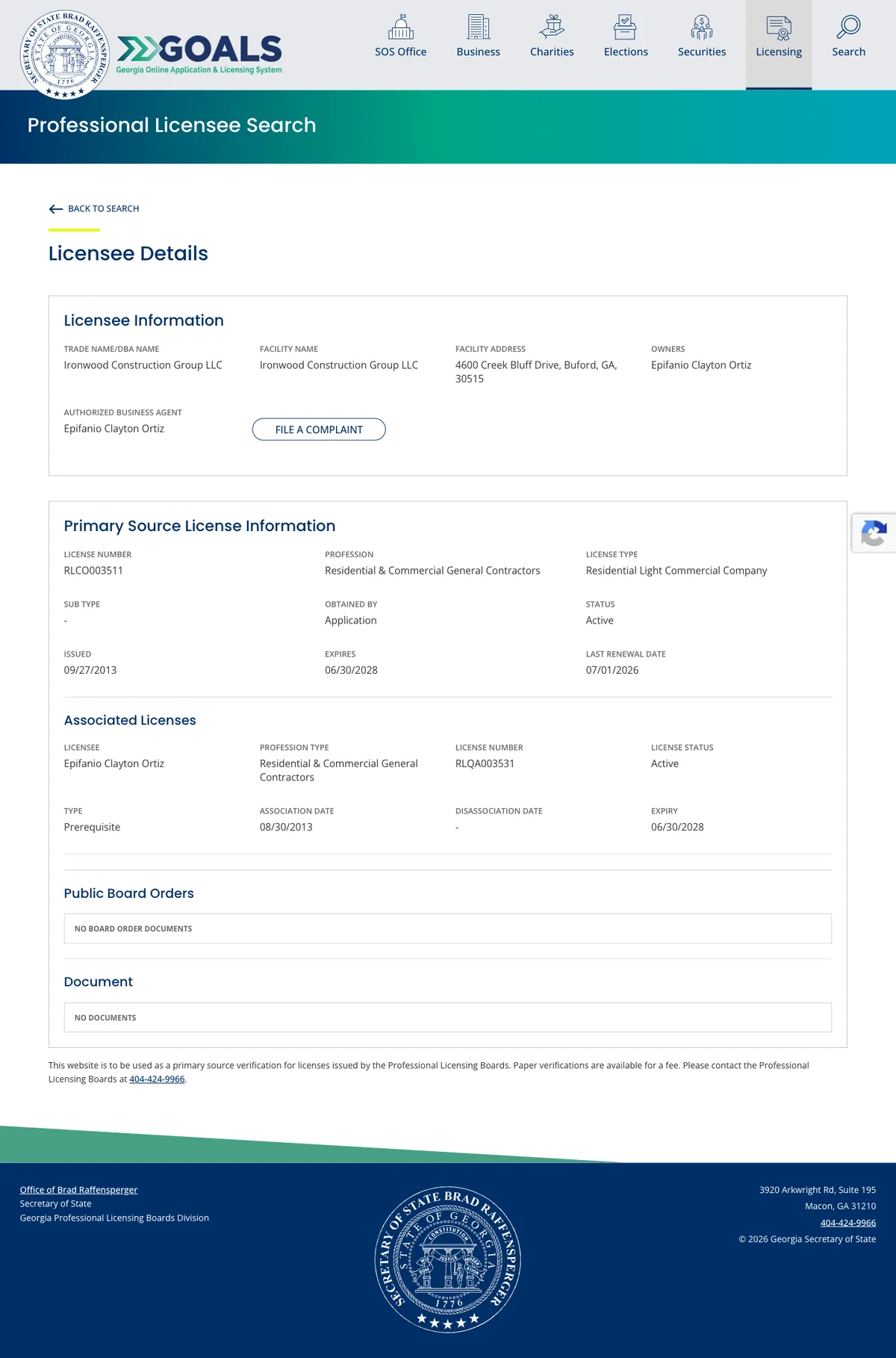
Step 3: Read the record: status, expiration and license type
Three fields matter most on the record.
- Status. It should read Active. Lapsed, expired or revoked means stop and ask questions.
- Expiration date. Make sure the license runs well past your expected build, which for a custom home is often more than a year.
- License type. Residential licenses come in two classes: residential-basic and residential-light commercial. Light commercial is the broader of the two.
Step 4: Confirm the business is registered with the state
The business you sign with should be registered too. On the same website, choose Business, then Search for a Business, and look up the company name. You want to see it listed and in good standing.
Step 5: Ask for a current certificate of insurance
In most cases a residential or general contractor must carry general liability insurance, and a business with three or more employees must also carry workers' compensation, according to the Attorney General's office. Ask for a certificate of insurance sent straight from the insurance agent, with you named as the certificate holder. Most contractors also need a city or county business license, which you can confirm with your local government.
What each check tells you
| Check | Where to do it | What a good result looks like |
|---|---|---|
| State contractor license | sos.ga.gov, Licensee Search | Your builder's name, status Active, expiration after your move-in |
| Business registration | sos.ga.gov, Business Search | Same company name as the contract, in good standing |
| Insurance | Certificate from the builder's agent | General liability in force; workers' comp if three or more employees |
| Local business license | Your city or county | Current license for the jurisdiction where you are building |
The wrong way vs. the right way to check a builder
Most of the warning signs show up in how the checks go.
| The wrong way | The right way |
|---|---|
| Taking a license number on faith, or accepting one that belongs to someone else | Looking it up yourself and matching it to the builder's name |
| Signing with a company whose name differs from the license or state business record | Asking why before you sign, and getting the names to match |
| Accepting an insurance certificate the builder hands you | Getting it sent straight from the insurance agent |
| Checking once and forgetting the expiration date | Making sure the license is not lapsed and will not expire mid-build |
| Pulling the building permit in your own name as the owner | Having the licensed builder pull the permit |
Advantages of each way to search
Advantages of searching by license number
- It returns exactly one record.
- It confirms the number the builder gave you is real.
- It avoids mixing up companies with similar names.
Advantages of searching by company name
- It works before you have a license number in hand.
- It shows whether the business has more than one record, or a similar name.
- It helps catch a contract name that does not match the license.
When to do it
- Before the first meeting: ask for the legal business name and license number in writing.
- Before you sign: run all five checks and match the contract name to the license and business records.
- Before construction starts: confirm the builder, not you, is pulling the permit.
- If your build runs long: check the license and insurance again before they expire.
How Ironwood shows its license
Ironwood Construction Group holds Georgia residential-light commercial license RLCO003511, active through June 30, 2028. We are a father-and-son team, Clay and Levi Ortiz, building in north Gwinnett and Hall County since 2008. Please do not take our word for it: run the five steps above on us, then talk to the builder directly.
Frequently asked questions about Georgia contractor licenses
Do roofers and painters need a Georgia state license?
No. Georgia does not license specialty trades such as roofers, painters, drywall installers and repair handymen at the state level. They may still need a local business license from the city or county where they work.
Who licenses plumbers and electricians in Georgia?
Plumbers, electricians and air-conditioning contractors are licensed by the Georgia Construction Industry Licensing Board, which is separate from the board that licenses residential and general contractors.
What should I do if a contractor is not licensed?
Do not sign. You can report unlicensed activity through the Secretary of State's complaint form on sos.ga.gov.
Does a city or county business license replace the state license?
No. A local business license lets a company operate there. It does not show the company passed the state exam or met its insurance requirements.
How often should I check a builder's license?
Check before you sign, and check again if your project runs long. Licenses must be renewed, so confirm the expiration date covers your whole build.
Sources
- Georgia Secretary of State, Residential and Commercial General Contractors FAQ, sos.ga.gov
- Georgia Secretary of State, Licensing Division License Lookup, sos.ga.gov
- Rules of the State Licensing Board for Residential and General Contractors, Rule 553-3-.01, rules.sos.ga.gov
- Georgia Attorney General Consumer Protection Division, "How can I verify that a contractor is licensed and insured?", December 13, 2023
- Georgia Attorney General Consumer Protection Division, Home Building and Home Repairs/Improvements