No Model Home? How to Tour a Small Builder's Finished Work Instead
Quick answer: Most small custom builders do not keep a model home, so ask to tour their real work instead: a finished home a past client is willing to show, and a house under construction. Look at the details a model would hide, ask the homeowner how the build went, and compare what you see with the builder's photos and reviews.
Large builders in Hoschton's newer communities can staff a decorated model home every weekend. A small custom builder usually cannot, and that is not a bad sign. The National Association of Home Builders notes that custom builders often build fewer than 10 homes a year. Here is how to get the same confidence a model home gives you, and often more, from a builder's finished homes and job sites.
Why don't small builders have model homes?
A model home is a sales tool for a builder who sells the same plans over and over. A custom builder designs each home for one family on one lot, so there is no single plan to show. The honest substitute is the work itself: homes that people actually live in, and houses being built right now.
Model home vs. finished-home tour
| What you learn | Model home | Finished-home tour |
|---|---|---|
| Design ideas | Staged, often with upgraded finishes | Real rooms, real furniture, real storage |
| Build quality | New and untouched | How the house holds up after people live in it |
| The owner's view | Not available | Ask the homeowner directly how the build went |
| Hidden work | Covered by drywall | Visible if you also tour a job site |
| Who you meet | A sales agent | Often the builder |
| Availability | Set weekend hours | By appointment, at the homeowner's convenience |
How do you set up a tour of a builder's finished work?
Ask, and give the builder some notice. A homeowner who opens their house is doing everyone a favor, so tours usually happen by appointment.
- Start with the portfolio. Look through the builder's gallery and custom builds and pick two or three homes closest to what you want: similar style, lot type or size of family.
- Ask for a finished home and a job site. One shows the result, the other shows the work behind the walls. If a lived-in home is not available, ask to speak by phone with a recent client instead.
- See a house mid-build. Framing and rough-in stage is the best time. You can see how clean the site is, how the framing is put together and how the trades leave their work.
- Bring your list. Take the questions below, a phone for photos (ask first) and anyone who will share the decision.
- Check it against the paperwork. After the tour, read the builder's reviews and confirm the license on the Georgia Secretary of State lookup. Georgia's Attorney General's Consumer Protection Division advises asking for references from customers with similar projects, contacting them and inspecting the work yourself if you can.
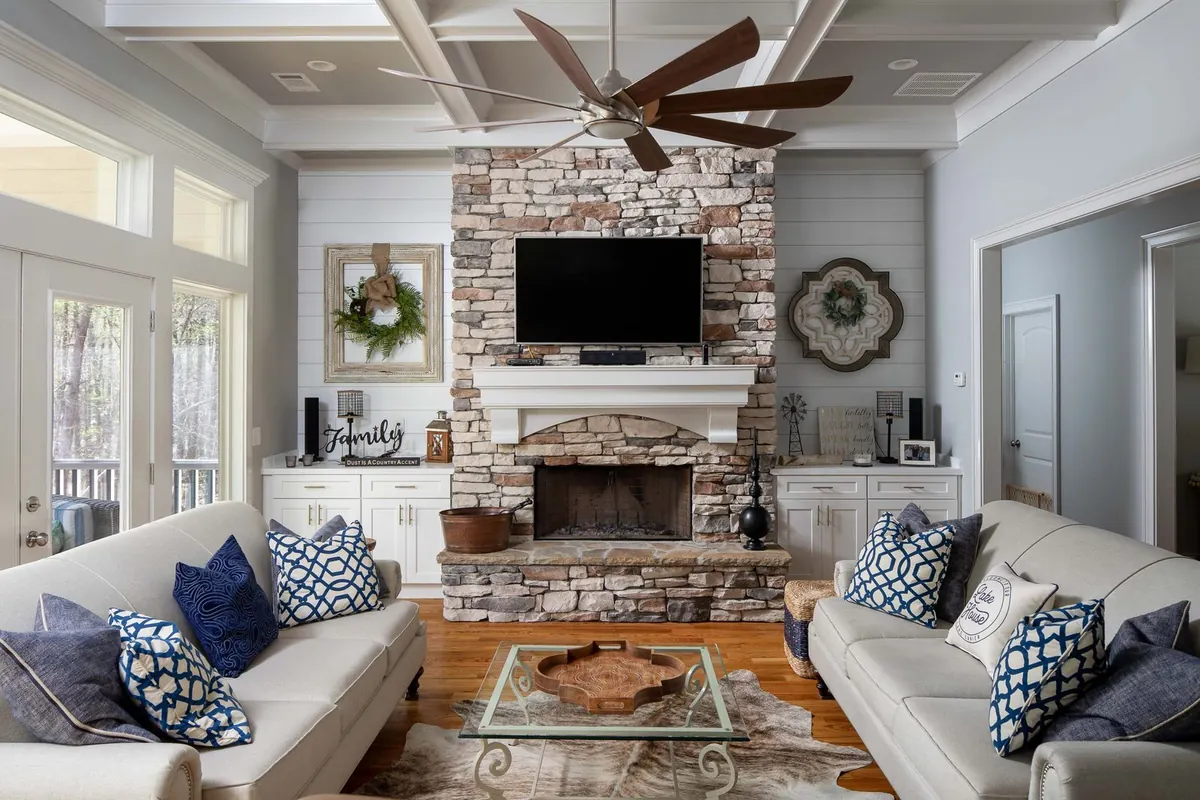
What should you look at on the tour?
Look at the places a model home would never be judged on: the details that take time and care.
- Trim joints, stair rails and cabinet alignment.
- Tile edges, grout lines and the transitions between floors.
- Doors that close cleanly and windows that open easily.
- Drainage around the house, grading and the driveway after a season of rain.
- The attic, crawlspace or unfinished basement, if the homeowner agrees.
The wrong way vs. the right way to tour a builder's work
A tour is only as useful as what you look at and who you ask.
| The wrong way | The right way |
|---|---|
| Judging the builder by staging and furniture | Looking at trim joints, tile edges, doors and drainage |
| Touring only a finished home | Also seeing a house at framing and rough-in |
| Letting the builder do all the talking | Asking the homeowner how the build really went |
| Taking photos without asking | Asking the homeowner first |
| Deciding on the drive home | Checking reviews, the license and references afterward |
Advantages of a finished-home tour and a job-site visit
Advantages of a finished-home tour
- You see how the house holds up after people live in it.
- You can ask the homeowner about schedule, changes and follow-up.
- Real rooms and storage show how a design works day to day.
Advantages of a job-site visit
- You see framing, wiring and plumbing that a finished home covers up.
- You see how clean the site is and how the trades leave their work.
- You often meet the people who would build your house.
When to do what
- Before you ask for a tour: browse the builder's gallery and pick the homes closest to yours.
- A week or two ahead: request the tour, so the homeowner has notice.
- During framing or rough-in: visit the job site, before insulation and drywall.
- Within a few days of the tour: read the reviews, check the license and call a reference.
Questions to ask on the tour
Ask the homeowner:
- Did the build finish close to the schedule you were given?
- How did the builder handle changes and surprises?
- Who did you talk to during the build, and how quickly did they reply?
- What came up after move-in, and how was it handled?
- Would you build with this builder again?
Ask the builder:
- Who will be on site day to day?
- How will I see progress between visits?
- What did you learn on this house that you would do differently?
How Ironwood shows its work
Ironwood Construction Group is a family-owned builder, Clay Ortiz and his son Levi, building custom homes in Hoschton, Braselton and across north Gwinnett and Hall County since July 2008. We do not keep a model home because we do not build spec homes; every house is drawn for one family. Our work is in our gallery, our Best of Houzz awards run from 2020 through 2025, and you talk to the builder directly. If you would like to see more of what we build, talk to the builder.
Frequently asked questions about touring a builder's work
Is it normal for a custom builder not to have a model home?
Yes. Model homes suit builders who repeat the same plans. A custom builder designs each home for a specific family and lot, so the real homes and job sites are the better showcase.
Can I visit a house that is still under construction?
Usually, with the builder present and with proper footwear. Job sites are active work areas, so the builder will set the time and route.
What if no past client can host a tour?
Ask for phone numbers of two or three recent clients, plus photos of homes at different stages. A good builder can connect you with people who will talk.
What is the best stage to see a house mid-build?
Framing and rough-in, before insulation and drywall. That is when you can see the structure, wiring and plumbing that a finished home covers up.
How many homes should I tour?
One finished home and one job site is a good minimum. Add more if they differ a lot from what you plan to build.
Sources
- Georgia Attorney General Consumer Protection Division, Home Building and Home Repairs/Improvements, consumer.georgia.gov
- Georgia Secretary of State, Licensing Division License Lookup, sos.ga.gov
- National Association of Home Builders, "Custom Homes" consumer resource