What "Affordable Custom Home" Really Means, and How to Tell Semi-Custom From True Custom
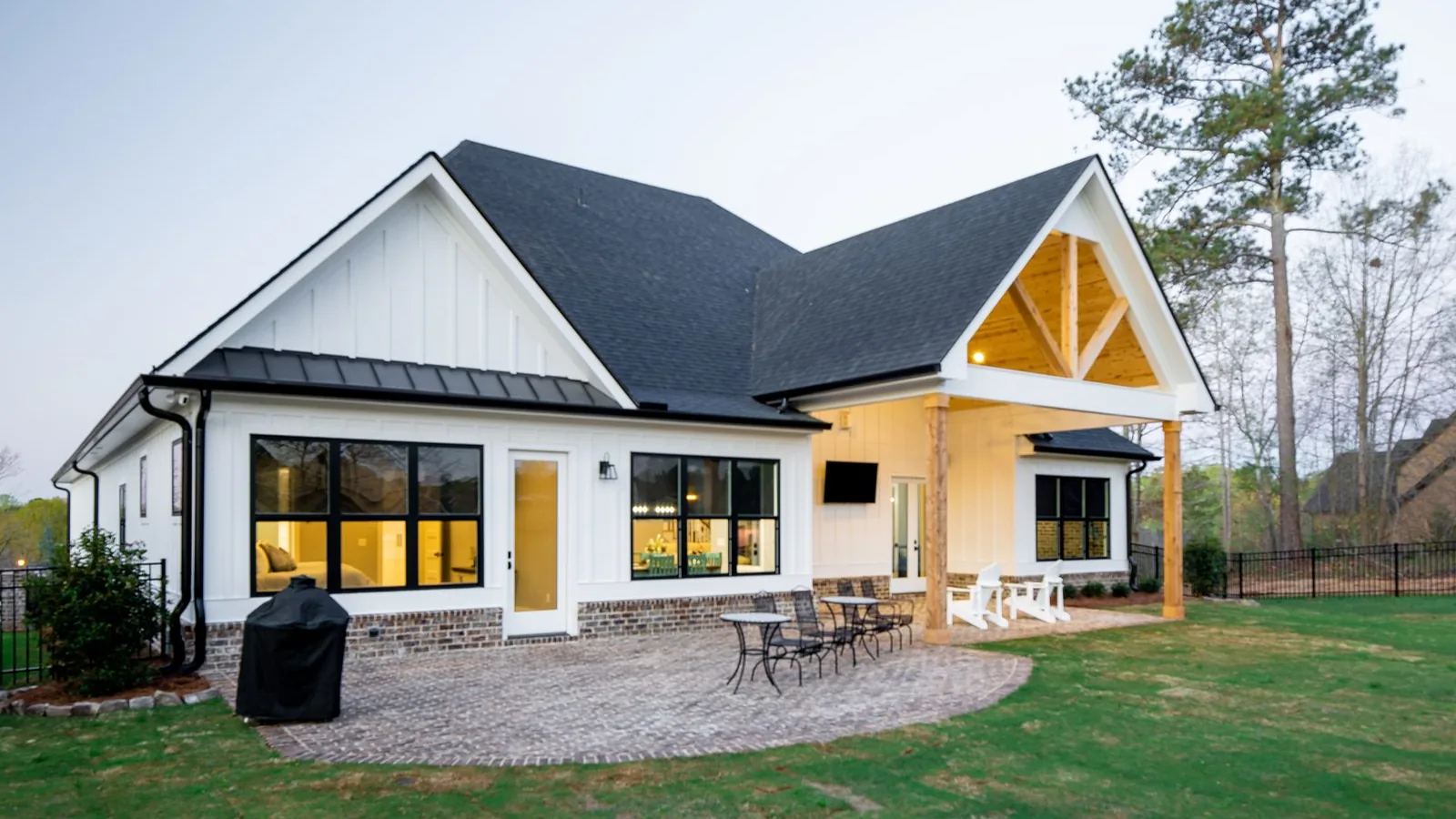
Quick answer: "Custom" covers three ways to build. A production home comes from a builder's plans in a builder's community, with set options. A semi-custom home starts from a builder's plan, often on your lot, with limited changes. A true custom home is designed around your family and land. "Affordable custom" usually means semi-custom.
Drive around Flowery Branch and you will see "custom homes" on billboards for new communities, on yard signs near the lake and in online ads for affordable custom building. The word is not a legal term, and builders use it to mean different things. This guide explains the three main ways new homes are built and how to tell which one you are being offered.
Why is "custom" such a slippery word?
Because no rule defines it. Any builder can call any home custom. The National Association of Home Builders draws the clearest line: a production builder builds communities from a group of preselected home styles on land the builder owns, while a custom builder often builds on the customer's land and starts fresh with each design (NAHB). Semi-custom sits between the two, and it is where most "affordable custom" offers land.
What is a production home?
A production home is built by a builder who owns the land, plans the community and offers a menu of floor plans. NAHB describes buyers touring a model home while the builder's agent explains which features are standard and which are optional. You pick a plan and choose from set options for appliances, countertops, flooring, cabinets and some fixtures, and you can usually make modest changes, such as swapping a tub for a larger shower or adding a patio, "but not to the extent possible with a custom builder" (NAHB). Production builders build many homes each year, which keeps the process predictable.
What is a semi-custom home?
A semi-custom home starts from a plan the builder already has, then changes parts of it. Depending on the builder, that can mean moving interior walls, enlarging a room, adding a bonus room or reworking the kitchen, with finishes chosen from a wider list than a production builder offers. Some semi-custom builders build in their own communities; others will build their plans on your lot. The limits are set by the builder: how far a plan can stretch, which walls can move, and which materials are on the list.
What is a true custom home?
A true custom home is designed for one household and one piece of land. The plan may begin from a sketch, an architect's design or a base plan that is reworked until it fits, but nothing about the layout, structure or finishes is locked in advance. NAHB notes that custom builders often work on fewer than 10 homes a year and spend more time on each project. By NAHB's narrow definition, homes built on contract for the owner make up about 20% of single-family starts on a one-year average (NAHB Eye on Housing, August 2026).
Production vs. semi-custom vs. true custom at a glance
| Factor | Production | Semi-custom | True custom |
|---|---|---|---|
| Who owns the land | The builder, in its community | The builder, or you | Usually you |
| Starting point | The builder's plan list | The builder's plan, then changed | Your needs, your lot, a blank page or a base plan |
| Layout changes | Small, from a preset list | Moderate, within the builder's limits | Open, as long as it can be built and permitted |
| Finishes | Set packages and upgrade tiers | Wider list chosen by the builder | Your choice, from any source the builder can install |
| Fit to the lot | Plan chosen for the community lot | Plan adjusted to the lot | Designed around slope, views and sun |
| Who you deal with | Usually a sales agent and design center | Varies; often a sales or design staff member | Usually the builder directly |
| Decisions you make | Fewest | Some | Many |
| Timeline | Most predictable | Moderate | Longest; design adds months |
What does "affordable custom home" usually mean?
In most ads it means a semi-custom home: a builder's existing plans, a set range of options and a streamlined process. That is not a bad thing. The problem is only when the words promise more freedom than the contract delivers, so ask the questions below before you sign.
How can you tell which one you are being sold?
Ask these questions early, and ask for the answers in writing. A builder who builds true custom homes will answer them easily; a semi-custom builder will tell you where the limits are; a production builder will point you to the option list.
- Can you build on my lot, or only in your communities? Production builders almost always build on their own land.
- Do I have to start from one of your plans? If yes, ask how far a plan can change.
- Can we move exterior walls and change the roofline, or only interior walls? Exterior and structural changes are where semi-custom limits usually sit.
- Who draws the changes, and is there a limit on revision rounds? This tells you how much design work is included.
- Can I choose finishes outside your list? Ask whether you can bring your own tile, lighting or plumbing fixtures.
- What is fixed once I sign? Some builders lock the plan at contract; others allow changes through change orders.
- Who will I talk to during the build? A sales agent, a project manager or the builder.
- Can I see a home you built that was not one of your standard plans? A finished one-off home is the best proof of true custom work.
The wrong way vs. the right way to compare custom builders
Most mix-ups come from comparing labels instead of what each contract allows.
| The wrong way | The right way |
|---|---|
| Taking "custom" in an ad at face value | Asking which of the three ways the builder actually builds |
| Comparing builders by their brochures | Comparing what each one lets you change, in writing |
| Assuming a plan can stretch as far as you need | Asking whether exterior walls and the roofline can move |
| Choosing a builder before you know your lot | Settling whether you need to build on your own land first |
| Finding out what is locked after you sign | Asking what is fixed at contract and how change orders work |
| Judging from model homes only | Touring a one-off home the builder designed for a client |
Advantages of semi-custom and true custom
If you want a home in a specific community with the fewest decisions, a production home is the simplest route. Most families reading ads for affordable custom homes are choosing between the other two.
Advantages of semi-custom
- Reusing a plan that has been built before cuts design time and reduces surprises during construction.
- Fewer decisions, with finishes chosen from a set list.
- A good fit when a builder's plan already covers most of your needs.
- Some builders will build their plans on your lot.
Advantages of true custom
- The home is designed around your lot's slope, views, shape and sun.
- Layout and structure are open, within what can be built and permitted.
- Needs such as a main-floor suite, a multigenerational layout or a large workshop are planned in from the start.
- You usually work with the builder directly.
Many Flowery Branch families land between the two. Reworking a base plan, such as one of our floor plans, can be the fastest route to a true custom result, as long as the builder allows real changes.
When to do what
- Before you talk to builders: decide whether you will build on your own lot or in a community.
- At the first meeting: ask the questions above and get the answers in writing.
- Before you choose a builder: tour a finished home that was not one of their standard plans.
- Before you sign: confirm what is fixed at contract, how changes are handled and who you will talk to during the build.
How Ironwood builds in Flowery Branch
Ironwood Construction Group is a family-owned builder, founded in 2008 by Clay Ortiz, who builds with his son Levi. We build custom homes on homeowners' lots in Flowery Branch, Hall County and north Gwinnett, and we do not build spec homes. Our free floor plans are a starting point, not a menu, and you talk to the builder directly, not a sales rep. If you are comparing semi-custom offers with a custom build, bring the questions above and talk to the builder.
Frequently asked questions about semi-custom and custom homes
Is semi-custom the same as custom?
No. A semi-custom home starts from a builder's existing plan with a defined set of changes. A true custom home is designed around one family and one lot, with no fixed limit on layout or finishes beyond what can be built and permitted.
Can a semi-custom home be built on my own lot?
Sometimes. Some semi-custom builders build only in their own communities; others will build on land you own. Ask early.
Is a semi-custom home faster to build?
Usually. Reusing a proven plan cuts design time, while a true custom home adds months of design before construction starts.
How do I know if a builder really builds custom homes?
Ask to see a finished home that was not one of the builder's standard plans, and ask whether you can move exterior walls, change the roofline and choose finishes outside a set list.
Is a spec home a type of semi-custom home?
No. A spec home is built before there is a buyer, so the builder chooses everything. We compare spec homes and custom homes in a separate post on spec versus custom builds.
Sources
- National Association of Home Builders, "Custom Homes: Design Trends, Benefits and Sustainability," consumer resource
- National Association of Home Builders, "Production Homes: Benefits and Trends," consumer resource
- National Association of Home Builders, Eye on Housing, "Flat Conditions for Custom Home Building," August 19, 2026